Thursday, September 9, 2010
Art Show
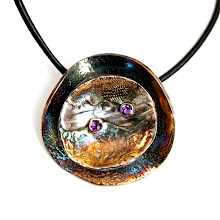
I just had the opening of my second solo Art Show. Doing a solo art show really tests how much art an artist can make and making art that works together as a cohesive show. Last year I did a show based on spiritual jewelry which is what I do . This year I collaborated with two fellow artists who do photography to do a garden themed show. All the jewelry was related to a garden or color as we did bring in the spiritual side of colors. I was very lucky and received a write up in today's local paper about the show. Online it doesn't show a picture but they used the piece above and below is the link to the article.
http://www2.timesdispatch.com/entertainment/2010/sep/09/w-gall09-ar-495863/
Monday, September 6, 2010
Color of the First Chakra
The color red is associated with the root chakra and taking a moment to focus on an everyday red object, such as a flower, will help to keep this chakra in tune. We can also use red crystals or gemstones, such as rubies and garnets, to work with the root chakra.
Saturday, September 4, 2010
First chakra continued
Chakras are more than just physical connections, however.
The first chakra connects the spirit with the physical world. To find a spiritual balance in the root chakra, focus on connecting your body and soul with the earth. Begin by grounding yourself by standing tall with your eyes closed. Imagine roots growing from your feet and into the earth, grounding you with the land below you. Meditate quietly on being grounded while you visualize yourself becoming one with the earth.
Friday, August 27, 2010
First Chakra continued
Located at the base of the spine, the Muladhara, also known as the root or base chakra, helps us relate to life force energy and helps to ground us. “Muladhara” actually means “foundation,” which really tells a lot about this chakra.
This chakra is linked to survival instincts. When our energy flows easily through our first chakra, we feel that we can meet all our needs without worry. When it is blocked, we will start to worry and feel anxious.
The base chakra is what starts us on any new venture and motivation happens because of our base chakra. You will often hear the first chakra referred to as the “tribal chakra,” as it also relates to how we deal with our family or our “tribe.”
The root chakra governs the spinal column, kidneys, feet, legs and immune system, so a blocked chakra can cause physical problems in these areas. Exercises such as power squats and the yoga position known as "bridge" can help to keep the first chakra open and balanced. The warrior position is also very good for stabilizing your base chakra.
Friday, August 20, 2010
First Chakra
Sanskrit Name: Muladhara
Location: Base of Spine
Color: Red
Mantra-LAM
Located at the base of the spine, the Muladhara, also known as the root or base chakra, helps us relate to life force energy and helps to ground us. Muladhara actually means foundation which really tells a lot about this chakra. This chakra is linked to survival instincts. When our energy flows easily through our first chakra we feel that we can meet all our needs without worry. When it is blocked we will start to worry and feel anxious. The base chakra is what starts us on any new venture and motivation happens because of our base chakra. You will often hear the first chakra referred to as the tribal chakra as it also relates to how we deal with our family or our “tribe.”
Location: Base of Spine
Color: Red
Mantra-LAM
Located at the base of the spine, the Muladhara, also known as the root or base chakra, helps us relate to life force energy and helps to ground us. Muladhara actually means foundation which really tells a lot about this chakra. This chakra is linked to survival instincts. When our energy flows easily through our first chakra we feel that we can meet all our needs without worry. When it is blocked we will start to worry and feel anxious. The base chakra is what starts us on any new venture and motivation happens because of our base chakra. You will often hear the first chakra referred to as the tribal chakra as it also relates to how we deal with our family or our “tribe.”
Sunday, August 15, 2010
More on Meditation
In Buddhism, meditation is often enhanced by meditation or singing bowls. As the name suggests, these instruments are bowls that produce a clear vibrant tone when played. The soft, continuous singing sound is produced by rubbing a mallet around the rim, much the same way a crystal goblet can be made to ring by rubbing a finger around its mouth.
The mallet can also be used to gently strike the side of the bowl to produce a ringing like that of a bell.
Wednesday, August 11, 2010
Meditation Continued
Meditation has other benefits. It is almost impossible to fully focus on two things at once and a mind that is completely absorbed in the feeling of each breathe, or in the vibrations of a chant cannot also be focused on its own troubles or unhappiness.
Meditation will not fix the cause of our problems but it can help us to adjust our own attitudes and responses. As Sri Swami Venkatesananda said, “A problem that is forgotten does not exist, unhappiness that is forgotten is happiness. It can come back again, but never mind.” A person who is unhappy all day but who takes 20 minutes to meditate and clear his mind will find that for those 20 minutes at least, his unhappiness is gone. “That is marvelous; the unhappiness was a mental state, nothing more than a mood.”
Monday, August 9, 2010
Meditation
Meditation
Meditation is the millennia-old practice of calming the mind through prayer, chanting, focused breathing or other means. Every religion has its own form of meditation---Catholics recite the rosary, Muslims pray toward the east five times each day and Hindus chant the word “om.” While the ways and means are different, the goal is the same – to relax and free the mind, opening our consciousness and bringing us closer to the divine.
Tuesday, July 13, 2010
Birthstones
January-Garnet
February-Amethyst
March-Aquamarine
April-Diamond
May-Emerald
June-Pearl or Alexandrite
July-Ruby
August-Peridot
September-Sapphire
October-Opal
November-Topaz or Citrine
December-Blue Zircon or Blue Topaz
February-Amethyst
March-Aquamarine
April-Diamond
May-Emerald
June-Pearl or Alexandrite
July-Ruby
August-Peridot
September-Sapphire
October-Opal
November-Topaz or Citrine
December-Blue Zircon or Blue Topaz
Wednesday, June 16, 2010
Balance and the Chakras
Word circle made of pure silver from Jewelry by Heart2Heart
Sunday, June 6, 2010
Last night I attended an event for Alzheimers to raise money sponsored by the Alzheimer’s Association, National Capital Area Chapter in Virginia.
This group put on a truly wonderful event. My friend Tara invited me to go with her as she had been invited as a special guest. It was a wonderful evening full of music and a reminder of this disease and that we all need to do what we can to help the research continue. I lost my mother to this disease 2 years ago. In her honor I started a line of jewelry that I call the forget-me-nots. It is the official flower of the Alzheimer’s association. They are hand made out of pure silver. Each leaf is sculpted and the flower is created petal by petal. Then a sapphire is hand set in the center of each one. These are truly a labor of love and I think they can honor someone special.
In honor of my mother a percentage of all sales are donated to the Richmond Alzheimer association. To see our press release click on the link.
http://www.jewelrybyheart2heart.com/images/h2hpr20090707.pdf
This group put on a truly wonderful event. My friend Tara invited me to go with her as she had been invited as a special guest. It was a wonderful evening full of music and a reminder of this disease and that we all need to do what we can to help the research continue. I lost my mother to this disease 2 years ago. In her honor I started a line of jewelry that I call the forget-me-nots. It is the official flower of the Alzheimer’s association. They are hand made out of pure silver. Each leaf is sculpted and the flower is created petal by petal. Then a sapphire is hand set in the center of each one. These are truly a labor of love and I think they can honor someone special.
In honor of my mother a percentage of all sales are donated to the Richmond Alzheimer association. To see our press release click on the link.
http://www.jewelrybyheart2heart.com/images/h2hpr20090707.pdf
Tuesday, May 25, 2010
Oms-What do they mean
Om is a sacred syllable in the Hindu, Buddhist and Jain religions. The meaning of the symbol is complex and differs somewhat in each religion but it can be viewed simply as a representation that helps us to realize the divinity and the energy that run through the entire universe.
Indian spirituality holds that God first created sound and the rest of the world sprang from its frequencies. Om is the most sacred of all sounds – the syllable from which the gods were created and the syllable that existed before the universe. The syllable “om” is also said to be the cosmic vibration that holds together the atoms of the world and of the heavens.
In Hinduism, each of the curves of the om carries its own symbolism. The largest lower curve –the bottom half of the 3—symbolizes the state of wakefulness, where consciousness is turned outwards through the senses. This largest curve represents wakefulness because the majority of the human consciousness occurs while we are awake and aware. The upper curve – the top part of the 3 – denotes the unconscious state of deepest sleep; that without desires or dreams. The middle curve – the hook on the right – symbolizes the dream state where consciousness is turned inward and the world is viewed through the eyes of the dreamer.
Indian mystic thought holds that all of reality springs from these three states of consciousness. Therefore, the three curves of the Om represent out entire physical phenomenon.
The dot signifies the fourth state of consciousness, which looks neither outward, nor inward. This is the quiet, peaceful state of bliss that is the aim of spirituality. The semi-circle beneath the dot represents the maya, which separates the state of bliss from the three states of consciousness. The illusion of the maya keeps us from realizing the state of bliss but just as the semi-circle is open at the top and does not touch the dot, so the maya does not touch or affect the state of bliss; It merely seeks to block us from reaching the ultimate goal.
The Om is dualistic in nature. On one hand, focusing on the symbol and sound helps us to look beyond the reality before our eyes to seek instead the abstract and the unknowable. On the other hand, focusing on an Om also helps to make the abstract more knowable bringing us closer to the divine.
When we meditate, we chant the syllable “Om.” This deep sound resonates throughout the body, vibrating and attuning us to the cosmic vibrations of the universe and uniting us with the Divine. This helps our minds and souls to reach toward the untenable as we seek deeper truth.
No matter what our spiritual beliefs, the Om can help to bring us closer to the Divine as we understand it.
The Om is also a symbol of spiritual perfection and wearing an Om helps us to focus on the divinity and light that are in ourselves and also in everyone we meet.
Saturday, December 5, 2009
Colored Stone Hardness
When we talk about hardness in a colored stone we are talking about its resistance to scratches. We need to think about the hardness of a stone when we decide what type of jewelry the stone will best be used for. The Mohs scale was created by a professor from Germany named Friedrich Mohs. Stones are rated from 1 to 10 with 10 being the hardest. Diamond has a rating of 10 and is harder than any other gemstone. Rubies and sapphires which are both corundum have a rating of 9 and they are fine to be used as stones in rings. Those with a rating of under 7 will wear if used in a ring or a bracelet. That’s not to say you can’t do it but that you should wear them carefully.
Mohs Scale Examples
10. Diamond
9. Corundum
8. Topaz
7. Quartz
6. Orthoclase feldspar
5. Apatite
4. Fluorite
3. Calcite
2. Gypsum
1. Talc
Tuesday, November 10, 2009
Tahitian Cultured Pearls
Tahitian cultured pearls have been on the pearl market since sometime in the 70’s. They are what we think of as newcomers in the world of pearls. The majority of Tahitian cultured pearls come from the lagoons of Tuamotu Archipelago and the Gambier Islands. In the 1960’s the investigation started on how to culture the P. margaritifera in the French Polynesia. This is the type of oyster (a black lipped) that produces Tahitian pearls. They first had to produce a gem-quality and then they needed to establish a market to sell the pearls to. In the 1960’s and early 1970’s Tahitian pearls were not known outside of French Polynesia. A campaign to promote the pearls was successful but the farms faced the challenge to create quantities that were large enough to serve an international market. Tahitian cultured pearls are usually harvested in the spring and summer from May to November. Approximately 40% of the pearls that are implanted produce gem-quality cultured pearls. Only approximately 5% will be round and the top 1 to 2% will be of the finest quality. These pearls take approximately 22 to 26 months for their growth.
Tahitian cultured pearls are larger in size and seeing them as a size of 14 mm is common. The have colors like an eggplant purple, peacock green, metallic gray and some grayish blue. When they were first marketed they were marked as “black” because of their dark colors. There are three colors that are associated with Tahitian pearls. Peacock is a term for a color that is highly valued. It is a dark green gray to blue gray with rose to purple overtones. Aubergine which means eggplant in French is most often used to describe dark grayish purple. Pistachio is a term for yellowish green to greenish yellow Tahitian pearls.
Tahitian cultured pearls stand out because of their high value which is comparable to South Sea pearls but higher than other types of pearls. Their value is higher due to many factors including their larger size and unusual color. There are also fewer of them being produced than other types of pearls. A top quality Tahitian cultured pearl can cost in the thousands. If you had a pearl necklace with sizes that were graduated fro 10 to 14 mm it might retail for 40,000. Most Tahitian pearls measure between 8 mm and 14 mm.
Unlike Akoya pearls which are almost all spherical less than half of the Tahitian pearls are spherical. Tahitian pearls that have excellent luster are almost metallic. Surface quality can range from spotless which are extremely rare to heavily blemished. Because Tahitian pearls have a cultivation period of 2 years they usually have a 2 mm nacre all around the pearl. These pearls rarely have a visible nucleous or a chalkey appearance.
Tahitian cultured pearls are larger in size and seeing them as a size of 14 mm is common. The have colors like an eggplant purple, peacock green, metallic gray and some grayish blue. When they were first marketed they were marked as “black” because of their dark colors. There are three colors that are associated with Tahitian pearls. Peacock is a term for a color that is highly valued. It is a dark green gray to blue gray with rose to purple overtones. Aubergine which means eggplant in French is most often used to describe dark grayish purple. Pistachio is a term for yellowish green to greenish yellow Tahitian pearls.
Tahitian cultured pearls stand out because of their high value which is comparable to South Sea pearls but higher than other types of pearls. Their value is higher due to many factors including their larger size and unusual color. There are also fewer of them being produced than other types of pearls. A top quality Tahitian cultured pearl can cost in the thousands. If you had a pearl necklace with sizes that were graduated fro 10 to 14 mm it might retail for 40,000. Most Tahitian pearls measure between 8 mm and 14 mm.
Unlike Akoya pearls which are almost all spherical less than half of the Tahitian pearls are spherical. Tahitian pearls that have excellent luster are almost metallic. Surface quality can range from spotless which are extremely rare to heavily blemished. Because Tahitian pearls have a cultivation period of 2 years they usually have a 2 mm nacre all around the pearl. These pearls rarely have a visible nucleous or a chalkey appearance.
Thursday, November 5, 2009
Symbols in Jewelry
As a person who has been in the "fine"jewelry industry for years I would never have thought about wearing much less making jewelry for healing. I also never really thought about its meaning. There are many symbols that different groups wear and people from every culture have used spiritual symbols to focus their energies connect tot he metaphysical world and touch the divine. A sybol is symply an object, picture word sound or makr that represents something else. In spirituality and religion, symbols are instant cues that remind us of the Eternal. From the cross worn by Christians to the Om drawn by Hindus to the lotus flower portrayed by Buddhists, symbols help us to channel our throughts and intentions on spirituality. These spiritual representations also identify us to others who share our same path and journey. Finally, each symbol, whether a hamsa or a yin yang, is an immediate reminder of the divinity in ourselves and all those around us.
Wednesday, August 19, 2009
Making over my Blog
I have been trying to learn to be a regular blogger for quite awhile. I wasn't sure when I started why I wanted a blog. After all I'm not a writer. I struggle with spelling. However, I study gemstones and believe in their metaphysical properties and if I sat with you for half an hour you would understand that about me. I decided to take a class from Alyson Stanfield and Cynthia Morris. It is a 4-week class that I hope will help me to become a better blogger and really connect with my readers. In fact that is the assignment for today, to identify the people that I want to visit and read my blog. My hope is that anyone who visits will take an opportunity to read a bit but mostly I hope that anyone looking for information on gemstones will be a reader. I want to educate about the properties of gemstones as well as the metaphysical energy in them. Even if you just want to know what your birthstone should look like my hope is you will find that here. I do have a jewelry business that is based on gemstones but here I really hope to educate or help answer questions that people might have and haven't been able to find an answer.
Sunday, August 2, 2009
Gemstone Basics
Colored stones have had a very special desire by people for many centuries. Most gems come from the earth and they are inorganic. This means that they are from non-living matter. Some gems are organic which means they are produced by something that was or is a living organism. Pearls, coral and amber are examples of organic gems. No matter which they come from they are called natural gems to help point the difference out between a man-made stone.
Wednesday, July 29, 2009
South Sea Pearls
South Sea Cultured Pearls
South Sea pearls come from the largest mollusks in the world. The mother-of-pearl lining on the shell is used to make buttons and sometimes inlay work. This was the original focus of the harvest of the South Sea pearls.
South Sea Pearls are harvested in three major areas. Approximately 61% come from Australia, 29% come from Indonesia and about 10% from the Philippines. The Australian oysters tend to be the largest of the three producing the majority of the largest pearls. In Australia the harvest is done during the Southern Hemisphere’s winter which is June, July and August. During this time the water temperature is very low and the pearls have their most luster and color. The Indonesian pearls closely resemble the Philippine pearls. The largest difference is the size as the Indonesian pearls range from 8 to 13 mm rather than the 10 to 20 mm that the Australian pearls range. The harvest for the Philippine pearls is done during the wet season which is June through November. The other difference is the color. Indonesian pearls will produce more cream and yellow pearls as they focus on the gold-lipped variety. Australian pearls focus more on the silver-lipped variety and will produce more of the white pearls with overtones of rose’, blue or green.
One of the characteristics of a South Sea pearl is their large size. South Sea pearls range from 9 mm to 20 mm in diameter with most of them being around 13 mm. The growth period of a South Sea pearl is around 2 years. A South Sea oyster can be nucleated (have a bead inserted) up to 3 times and very often the third time will produce the largest pearl.
Because the South Sea oyster lives in warm waters they deposit a very thick coating of nacre 2 mm to 6 mm and this is done much more quickly than an oyster in a cooler climate. This thick nacre gives the pearl a soft glow rather than a metallic sheen. The glow also gives color. Silver, white and yellow are the most common colors that you will see. The color depends largely on if it is a silver-lipped or gold-lipped oyster. The edge of the mantle tissue will influence the pearl color. The silver-lipped variety will produce predominately white to silver pearls that might have a rose’, blue or green overtone. The gold-lipped variety will produce pearls that range mostly from yellow to yellowish orange which the trade may refer to as golden.
Strands of pearls are what we think of when we think of pearl jewelry. A strand of South Sea pearls would be very expensive so a lot of jewelry made with South Sea pearls uses individual pieces. Round and near round South Sea pearls only make between 10 to 30% of the harvest. Ovals, buttons and drops make 40 to 60% of the harvest with baroques making between 20 and 40%. Because of this you will find that other shapes than round give a greater opportunity for designing jewelry. Even though baroques don’t make up the majority of the harvest their prices are not pushed up so you will see them in many unusually designed pieces using South Sea pearls but at a reasonable price. Large Keishi pearls are very rare and a strand of keishi South Seas are in demand.
Typical rating for South Sea pearls luster is excellent, good and fair. The surface quality is considered either clean or lightly blemished and the nacre quality is graded as acceptable or not acceptable
South Sea pearls come from the largest mollusks in the world. The mother-of-pearl lining on the shell is used to make buttons and sometimes inlay work. This was the original focus of the harvest of the South Sea pearls.
South Sea Pearls are harvested in three major areas. Approximately 61% come from Australia, 29% come from Indonesia and about 10% from the Philippines. The Australian oysters tend to be the largest of the three producing the majority of the largest pearls. In Australia the harvest is done during the Southern Hemisphere’s winter which is June, July and August. During this time the water temperature is very low and the pearls have their most luster and color. The Indonesian pearls closely resemble the Philippine pearls. The largest difference is the size as the Indonesian pearls range from 8 to 13 mm rather than the 10 to 20 mm that the Australian pearls range. The harvest for the Philippine pearls is done during the wet season which is June through November. The other difference is the color. Indonesian pearls will produce more cream and yellow pearls as they focus on the gold-lipped variety. Australian pearls focus more on the silver-lipped variety and will produce more of the white pearls with overtones of rose’, blue or green.
One of the characteristics of a South Sea pearl is their large size. South Sea pearls range from 9 mm to 20 mm in diameter with most of them being around 13 mm. The growth period of a South Sea pearl is around 2 years. A South Sea oyster can be nucleated (have a bead inserted) up to 3 times and very often the third time will produce the largest pearl.
Because the South Sea oyster lives in warm waters they deposit a very thick coating of nacre 2 mm to 6 mm and this is done much more quickly than an oyster in a cooler climate. This thick nacre gives the pearl a soft glow rather than a metallic sheen. The glow also gives color. Silver, white and yellow are the most common colors that you will see. The color depends largely on if it is a silver-lipped or gold-lipped oyster. The edge of the mantle tissue will influence the pearl color. The silver-lipped variety will produce predominately white to silver pearls that might have a rose’, blue or green overtone. The gold-lipped variety will produce pearls that range mostly from yellow to yellowish orange which the trade may refer to as golden.
Strands of pearls are what we think of when we think of pearl jewelry. A strand of South Sea pearls would be very expensive so a lot of jewelry made with South Sea pearls uses individual pieces. Round and near round South Sea pearls only make between 10 to 30% of the harvest. Ovals, buttons and drops make 40 to 60% of the harvest with baroques making between 20 and 40%. Because of this you will find that other shapes than round give a greater opportunity for designing jewelry. Even though baroques don’t make up the majority of the harvest their prices are not pushed up so you will see them in many unusually designed pieces using South Sea pearls but at a reasonable price. Large Keishi pearls are very rare and a strand of keishi South Seas are in demand.
Typical rating for South Sea pearls luster is excellent, good and fair. The surface quality is considered either clean or lightly blemished and the nacre quality is graded as acceptable or not acceptable
Wednesday, June 24, 2009
Akoya Pearls

Akoya
Akoya is what we generally think of when someone talks about pearls. They speak of a white round gem. Akoya oysters are the main ones used for saltwear pearl culturing in both China and Japan. Most are cream or white and some have a tint of rose or green. The oyster itself is relatively small so it doesn’t produce a cultured pearl larger than 11 mm. What we see as the traditional strand of pearls are generally an Akoya pearls. They lend themselves to matching very well.
Akoya pearls were the first round or spherical cultured pearl and were introduced in the twentieth century. Japan and China are the primary sources for Akoya pearls but there are other areas that grow them including Korea, Southeast Asia, Australia the Persian Gulf and the Caribbean. In the 1940’s pearls were not readily available in all sizes for strands. Because of this graduated strands of cultured pearls were strung. Almost all necklaces before and immediately after World War II were graduated necklaces. U.S. servicemen brought home many of these necklaces for their moms, girlfriends and wives. This helped to create a demand and knowledge of the cultured pearl.
The Japanese growth period for Akoya pearls is 8 months to 2 years. Farmers will harvest Akoya pearls in the winter. The water is the coldest then and it will lead to a better cultured pearl quality. The longer the pearl grows generally the better the pearl.
The size of Akoyas are relatively small. They are available in sizes 2 to 11 mm in diameter but a 10 mm Akoya is very rare. The average size of an Akoya is 6 to 7 mm.
Most Akoya pearls are sold as strands and they are very well matched. A very high amount of pearls will receive an excellent rating in matching. This happens because a very high amount of Akoyas are round or near round. If all other value features are equal in an Akoya their value will raise as their size gets larger.
Akoya is what we generally think of when someone talks about pearls. They speak of a white round gem. Akoya oysters are the main ones used for saltwear pearl culturing in both China and Japan. Most are cream or white and some have a tint of rose or green. The oyster itself is relatively small so it doesn’t produce a cultured pearl larger than 11 mm. What we see as the traditional strand of pearls are generally an Akoya pearls. They lend themselves to matching very well.
Akoya pearls were the first round or spherical cultured pearl and were introduced in the twentieth century. Japan and China are the primary sources for Akoya pearls but there are other areas that grow them including Korea, Southeast Asia, Australia the Persian Gulf and the Caribbean. In the 1940’s pearls were not readily available in all sizes for strands. Because of this graduated strands of cultured pearls were strung. Almost all necklaces before and immediately after World War II were graduated necklaces. U.S. servicemen brought home many of these necklaces for their moms, girlfriends and wives. This helped to create a demand and knowledge of the cultured pearl.
The Japanese growth period for Akoya pearls is 8 months to 2 years. Farmers will harvest Akoya pearls in the winter. The water is the coldest then and it will lead to a better cultured pearl quality. The longer the pearl grows generally the better the pearl.
The size of Akoyas are relatively small. They are available in sizes 2 to 11 mm in diameter but a 10 mm Akoya is very rare. The average size of an Akoya is 6 to 7 mm.
Most Akoya pearls are sold as strands and they are very well matched. A very high amount of pearls will receive an excellent rating in matching. This happens because a very high amount of Akoyas are round or near round. If all other value features are equal in an Akoya their value will raise as their size gets larger.
Thursday, March 26, 2009
Pearl Value-Shape
Shapes
Round
In general the round pearl is the most valuable pearl shape. This is partly because a well formed round shape is relatively hard to find. Also most people recognize a round chocker of pearls.
Symmetrical
A symmetrical pearl also should have well proportion symmetry. The outline should not have irregularities.
Baroque
Baroque Pearls can have all different shapes; they can be shaped like a cone or a wing. Many times they are formed in the muscle tissue of the mollusk rather than its softer organs. If a pearl looks like it could be round but has an irregular deposit of extra nacre it is classified as a semi-baroque pearl. If all is equal in the valuing a baroque pearl will rank third behind spherical and symmetrical pearls.
Round
In general the round pearl is the most valuable pearl shape. This is partly because a well formed round shape is relatively hard to find. Also most people recognize a round chocker of pearls.
Symmetrical
A symmetrical pearl also should have well proportion symmetry. The outline should not have irregularities.
Baroque
Baroque Pearls can have all different shapes; they can be shaped like a cone or a wing. Many times they are formed in the muscle tissue of the mollusk rather than its softer organs. If a pearl looks like it could be round but has an irregular deposit of extra nacre it is classified as a semi-baroque pearl. If all is equal in the valuing a baroque pearl will rank third behind spherical and symmetrical pearls.
Subscribe to:
Posts (Atom)